Introduction
A leader is an individual who influences a group of people towards the achievement of a goal (Wong, 2007). This definition represents person, people and purpose. A good leader must be honest, have the ability to delegate, sense of humor, confident, committed, positive, and creative (Center for Creative Leadership, 2019). According to Hao and Yazdanifard (2015), Leadership is a type of power where an individual has the ability to influence or change the values, beliefs, behaviour and attitudes of another person. An individual with strong leadership ability will be a good example or role model to the people he/she leads, because a leader who is able to effectively achieve some good result or achievement gains the trust and admiration of their employees. In today’s organisation, an effective leader who understands the complexities of the rapidly changing global environment is required.
Leadership Styles
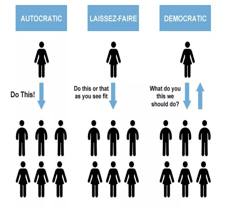
All leaders do not possess the same attitude or perspective but a perfect leadership style one which assists a leader in getting the best out of the people who follow him. Classic leadership style according to Kurt Lewin is autocratic, democratic and Laissez-faire. An autocratic leadership is when a leader is faced with the need to provide a decision; he/she is one who would come with a solution for the entire group on their own. Democratic leaders are those who took a very relaxed yet in control approach to leading the group. Laissez-faire leaders use the idea that the participants should be able to work problems out and make their way through an expedition without too much extra guidance. These types of leaders provide very little guidance when dealing with group issues and would allow employees to come up with decisions on their own (Val & Kemp, 2012).
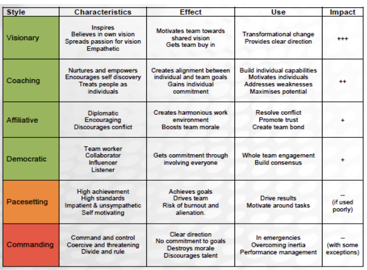
Daniel Goleman did a research and found that leaders use six styles of leadership. Each of the style springs from different components of emotional intelligence (Thuijsman, 2015). Provided below is the explanation of each of the leadership styles. None of the six styles are right or wrong, each has a time and place where it is appropriate depending on the specific context (The Da Vinci Institute, 2013).
Contemporary leadership styles are the most recent developments in leadership styles. Below are some examples of contemporary leadership styles:
- Transactional leadership: is a style that is based on the setting of clear goals and aims for the employees as well as the use of either penalties or rewards in order to encourage compliance with these goals (Thuijsman, 2015). It is action-oriented and focused on achieving predetermined goals.
- Transformational leadership: is a style that focuses on the development of employees as well as their needs. The leader that uses this style focuses on the growth and development of value system of employees, their inspirational level and principles with the preamble of their capabilities (Nanjundeswaraswamy & Swamy, 2014). A transformational leader has charisma, considerate, inspirational, and intellectual stimulates is followers (Mahomed, 2016).
- Situational leadership: this style is underlined by the concept that there is no one most effective, and that a leader adapt their leadership style to suit the task, people or project at hand. It has four interchangeable leadership styles which are; telling, selling, participating and delegating (HRZone, 2019).
Dangote Industries Limited
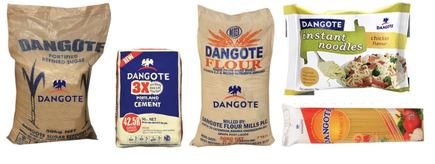
Dangote Industries Limited is a company founded in 1981 by Aliko Dangote to supply commodities such as cement, sugar, salt, pasta, noodles, rice, fabric etc. it is the largest indigenous industrial conglomerate in Sub Saharan Africa (Dangote.com, 2019). The company is striving for self-reliance in Nigeria in all sectors where it operates and has drawn up ambitious plans to set up world-class projects in new realms such as petroleum refinery and petrochemicals, fertiliser, gas pipeline, and energy (Dangote.com, 2019). Aliko Dangote’s leadership style can be classified as transformational leadership.
As a transformational leader, Dangote has created vision and ensured that the vision is translated into reality, which can be seen in the growth of the company all over Sub Saharan Africa. Transformational leaders have three main qualities which are self-confident, paying attention to their employees and arousing in their employees an awareness of problems and potential solutions (Charles, 2012). These qualities can be found in Dangote leadership style. As a self-confident leader, Dangote through persistence and hardwork launched the new cement plants in Cameroon, Ethiopia, Zambia and Tanzania despite the rate of poverty in Nigeria (Lanre, 2017). To solve the issue of unemployment in Nigeria, Dangote promised to create 210.000 jobs between 2016 and 2018 with 80% coming from agricultural sector. He has the vision and the vision has been turned into reality with the company partnering with out-growers to cultivate and grow rice paddy and sugarcane (Dangote, 2019). The company is building rice processing mills in Kano, Jigawa, Sokoto, Zamfara, Kebbi and Niger states to reduce rice import to nearly zero in Nigeria (Africanglobe.net, 2018). The leadership style of Dangote have allowed the company to grow in Nigeria and expanding to other Sub Saharan African countries as an example of a true African capitalism representing the new and innovative style of doing business in Africa (White and Rees 2018).
Conclusion
Aliko Dangote style of leadership should be based on the terrain of the country, the purpose of the organisation in terms of objectives, task, people or project. There is no size fits all leadership style. In the future, leaders should develop their leadership style based on the objectives and how to drive the objectives of the organisation and also promote employee engagement.
Reference
Africanglobe.net (2018). Aliko Dangote Pumping Billions Into Agriculture. [online] Africanglobe.net. Available at: https://www.africanglobe.net/business/aliko-dangote-pumping-billions-agriculture/ [Accessed 26 Jun. 2019].
Alao, V. (2018). What You Should Know About Dangote Group – Vision, Projects, Achievements and Businesses. [online] eeSPACE. Available at: http://eespace.com.ng/what-you-should-know-about-dangote-group-vision-projects-achievements-and-businesses/ [Accessed 26 Jun. 2019].
Anastasia. (2017). Laissez Faire Leadership Guide: Definition, Qualities, Pros & Cons, Example. Available at https://www.cleverism.com/laissez-faire-leadership-guide/ [Accessed 26 Jun. 2019].
Center for Creative Leadership. (2019). What Are the Characteristics of a Good Leader?. Available at https://www.ccl.org/blog/characteristics-good-leader/ [Accessed 27 Jun. 2019]
Charles, E. (2012). The Role of Managerial Leadership in Corporate Goal Attainment (A Case Study of Dangote Flour Mills Plc.). Masters in Business Management- University of Nigeria.
Dangote.com (2019). About Us – Dangote Industries Limited. [online] Dangote.com. Available at: https://dangote.com/about-us/ [Accessed 28 Jun. 2019].
Hao, M., & Yazdanifard, R. (2015). How Effective Leadership can Facilitate Change in Organizations through Improvement and Innovation. Global Journal Of Management And Business Research: A Administration And Management, 15(9).
HRZone. (2019). What is Situational Leadership?. [online] Available at: https://www.hrzone.com/hr-glossary/what-is-situational-leadership [Accessed 2 Jul. 2019].
Lanre, S. (2017). Uncovering Leadership Styles. Walden University.
Be Leaderly. (2019). Emerging Leader Spotlight: Megan Upp – Be Leaderly. [online] Available at: https://beleaderly.com/megan-upp/ [Accessed 4 Jul. 2019].
Mahomed, Y. (2016). The impact of different leadership styles on employee engagement in an organisation undergoing change (Doctoral dissertation, University of Pretoria).
Nanjundeswaraswamy, T. S., & Swamy, D. R. (2014). Leadership styles. Advances in management, 7(2), 57.
The Da Vinci Institute. (2013). Goleman’s Six Leadership Styles. Retrieved from http://dmcodyssey.org/wp-content/uploads/2013/08/Goleman%E2%80%99s-Six-Leadership-Styles.pdf [Accessed 5 Jul. 2019].
Thuijsman, T. (2015). Leadership styles and their influence on employees regarding the acceptance of organizational change. Bachelor Thesis Conference.
Val, C., & Kemp, J. (2012). Leadership Styles. Pathways: the Ontario journal of outdoor education, 24(3), 28-31.
White, L., & Rees, L. (2018). Dangote’s expansion: driving African capitalism. Emerald Emerging Markets Case Studies, 8(2), 1-25.
Wong, A. (2007). Definition of a Leader. Retrieved from http://www.vtaide.com/gleanings/leader.html [Accessed 5 Jul. 2019].

 Egbe Peter's Blog
Another very informative post. Please keep them coming.
LikeLike
Agreeable. Have you ever thought of what your leadership style is and why?
LikeLike
Is there a term for the leader who alternates between the various leadership styles? I would say this is the case for me as my philosophy of life is devoid of hard and fast rules/methods to solutions/approach. I would say limiting myself to one style is to limit my imaginative prowess in problem solving and adaptability.
LikeLike
I am more of a Transactional leader but will work on adapting transformational and situational leadership for greater outcome. Great article. Thanks for sharing
LikeLike
Thanks a lot, a leader should be able to motivate, inspire and encourage followers as these are some of the core qualities of a leader.
LikeLike
This is really a nice write up . i learnt so many things from this
LikeLiked by 1 person
I am glad you learned from this. Have you ever thought about your style of leadership?
LikeLike
Interesting article
LikeLike
Thanks
LikeLike